
Wire mesh for fencing and electrical protection: how to choose the right protection for your terrain
Gemi Elettronica ·
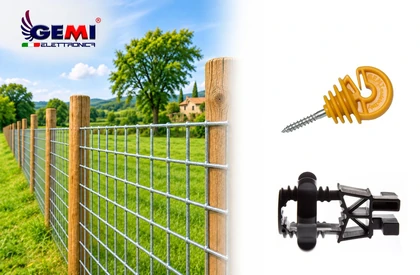
A wire fence can last for many years and clearly define a plot of land. Its effectiveness against animals, however, depends on details that often emerge only after the first damage: a mesh that's too wide, a lower edge that can lift, a gate that leaves space near the ground.
Before purchasing rolls and stakes, it's a good idea to carefully define the problem: containing chickens, marking out a pasture, or protecting a vegetable garden from incursions require different solutions, even when the perimeter seems identical.
The most effective choice comes from observing the terrain and the species present. In many contexts, a good physical barrier remains necessary; in others, it can be supported by a separate electrified conductor, which discourages contact and reduces pressure on the structure. Integration works when the fence, poles, and energizer are designed as parts of a single system, keeping their respective tasks separate.
The network must respond to animal behavior
Height is the most visible parameter, but it is not always the decisive one:
- Burrowing animals: They seek the lower passage.
- Climbing animals: they exploit supports and discontinuities in the mesh.
- Large or heavy items: These can deform a poorly supported section.
Doors also deserve great attention, as they concentrate openings, movement, and stress. A sturdy fence along the entire side can be vulnerable precisely at the point used every day to enter with a wheelbarrow.
Specific needs for poultry and pastures
- For poultry housing: the mesh must be chosen based on the number of birds to be contained and the predators to be excluded. The thin wire intended to restrain poultry does not automatically provide the required resistance against external intrusions.
- For a pasture: the stability of the posts, the visibility of the boundary and the possibility of avoiding entanglements become fundamental.
Defining these aspects before assembly allows you to purchase the right material without having to correct every single meter of fencing later.
Materials and installation matter as much as the price of the roll
No one type of network is universally superior:
- Electro-welded mesh: maintains a fairly regular geometry thanks to the welded connection points between the wires.
- Twist net: adapts better to certain terrain conformations.
To make the right choice, it is necessary to carefully analyze the wire diameter, mesh size, surface treatment, and intended use, avoiding relying solely on the product photograph.
| Feature / Element | Considerations for choosing |
|---|---|
| Galvanizing | It protects steel from corrosion, but cuts, abrasions and water stagnation can accelerate local deterioration. |
| Plastic coating | It adds a useful finish in certain environments, but does not make the quality of the underlying metal irrelevant. |
| Critical points | The most challenging conditions are concentrated at the edges, at the fixing points and close to the ground. |
The impact of the conformation of the land
The terrain profoundly changes the project:
- On a slope: a net mounted only along the top line can leave dangerous gaps at the base.
- In areas subject to runoff: water can wash away soil around the posts, compromising their stability.
- Corners and gates: require reinforced supports capable of absorbing traction.
Overstretching the material to correct an uneven installation transfers stress to the fasteners and can cause irreversible deformations over time. Leaving the perimeter accessible facilitates inspections and allows for intervention while the defect is still small.
When to add a separate electrified wire
Electric fencing offers a completely different function than simple mechanical resistance. The energizer generates short, spaced pulses; contact with the conductor, in a properly constructed circuit, produces a deterrent effect. For animals adapted to this system, the boundary is thus recognized and respected before being subjected to repeated jolts.
When to add it? Adding a conductor to an existing network is convenient when the structure is sound but frequently subjected to stress.
The wire must remain supported by compatible insulators and well separated from the metal of the fence, the conductive posts, and the vegetation. This spacing serves both to prevent leakage and to allow the animal to come into contact with the wire before it reaches the physical barrier.
Mistakes to avoid in electrification
DO NOT connect the control unit directly to the wire fence: a standard fence should not be transformed into an electrified fence by simply connecting the energizer output. Contact with the ground and supports would disperse the impulse, while the mesh could create a entanglement risk. Specially constructed electrified fences are completely different products.
NEVER electrify barbed wire.
The role of the Gemi solution in the project
For a fixed installation with available mains power, the Gemi E/220 Extraforte represents one of the main options to evaluate. The manufacturer's specifications list a power of 8 J , a maximum voltage of 15,000 V , and a declared range of up to 8 km in favorable real-world conditions. These data describe the device's power, but wire load and dispersion remain determining factors for actual performance in the field.
The key is being able to choose the energizer along with the dedicated components in the line: Gemi insulators for iron poles , for example, help keep conductors and supports perfectly separated when the project uses metal posts. The system's compatibility offers a significant practical advantage over a piecemeal purchase.
Size based on actual needs
The available power must always be commensurate with the animals and the structure:
- A high-powered model intended for demanding perimeters is not automatically the best choice for a small space frequented by pets.
- To size correctly you need: total length of the conductors , number of lines , presence of vegetation and soil characteristics .
From grounding to gate inspection
The electrical circuit requires a dedicated grounding system , constructed strictly according to the instructions in the manual. The ground electrode allows the impulse to return upon contact: excessively dry ground or deteriorated connections can limit its effectiveness, even with an active control unit. Separation from other grounding systems must also be maintained, avoiding improvised connections to the domestic network.
Management of gates and testing
- Passage to the gate: it is advisable to design a crossing (using underground high-voltage cables and insulated handles) that keeps the subsequent sections powered even when the passage is open.
- Final testing: Before putting the system into service, use a special tester to check the voltage near the appliance, at the access points, and at remote points. The simple "ticking" of the appliance does not measure actual performance.
An investment to be judged on the possible maintenance
Consider the case of a vegetable garden with a fence that's still intact but subject to repeated attempts to gain access along one side: installing an insulated wire alongside it allows you to preserve the existing structure and directly influence the animal's behavior. However, if the fence is corroded, has gaps, or doesn't protect the lower edge, these structural defects must first be corrected: electrification won't fix them.
The total cost includes materials, installation, and the time required to keep the perimeter clear. After severe weather events or agricultural work, an inspection prevents branches, bent mesh, or broken insulators from compromising the system.
The most cost-effective long-term solution is one that can be managed continuously: a well-laid network and properly separated electrical protection work synergistically to ensure the border is maintained.
Whether improving the livability of your home or protecting your land and livestock, choosing the right components makes all the difference. From smoke extraction systems like fireplace extractors to safety barriers like electric fencing , relying on certified, quality products ensures maximum efficiency, longevity, and complete peace of mind in your day-to-day operations.