




How many volts does an electric fence have? Voltage, power, and safety
Gemi Elettronica ·
When it comes to animal safety or crop protection, the most common question that arises concerns not only the physical resistance of the materials, but also the strength of the electrical impulse: how many volts does an electric fence have? It's often thought that higher voltage automatically equates to greater effectiveness, but the technical reality behind a professional energizer is much more complex.
Understanding how voltage works in an electric fence is essential not only to ensure a deterrent effect, but also to ensure the longevity of the system and, above all, the safety of the animals involved. In this guide by Gemi Elettronica, we'll explore the ideal parameters and the behavior of the current along the perimeter.
Output voltage: industry numbers
Generally speaking, an electric fence energizer produces a voltage ranging between 2,000 and 15,000 volts . These numbers might seem frightening when compared to the 230 volts in our homes, but there's a fundamental difference: the nature of the pulse. While household current is continuous and high-amperage (potentially lethal), electric fence current is emitted in the form of very short pulses, lasting a few milliseconds, separated by about a second from each other.
This interval is what makes the fence safe: the animal receives a shock that causes a muscle contraction and immediate discomfort, prompting it to move away, but without suffering permanent damage or remaining "attached" to the wire. The high voltage serves primarily to overcome the natural resistance of the animal's fur, skin, or feathers, ensuring that the impulse is actually felt.
Volts vs. Joules: A Necessary Distinction
To truly understand how powerful a fence is, you shouldn't just look at the volts, but also the joules. While volts represent the "pressure" that allows the current to pass through the air and the animal's skin, joules indicate the actual energy contained in each discharge.
Imagine electricity like water flowing through a pipe: volts are the water pressure, while joules are the amount of water flowing out. A fence energizer may have 10,000 volts, but if it has very few joules, the impact will be minimal and it won't be able to counteract the losses caused by tall grass. In contrast, a balanced system from Gemi Elettronica guarantees a high output voltage combined with a pulse energy adequate for the length of the fence, ensuring the shock is effective even from kilometers away from the control unit.
The ideal tension according to the animal
Not all enclosures need to have the same voltage. Each animal species has a different sensitivity and specific physical resistance that determines the "pain threshold" needed to create the psychological effect of the barrier.
For pets with short fur or sensitive skin, such as horses, a line voltage of around 2,000–3,000 volts is usually sufficient. Horses are extremely intelligent animals that quickly learn to respect boundaries. For cattle, it's recommended to maintain at least 3,500–4,000 volts , given their thicker fur and less sensitivity.
The greatest challenge is with wild animals, such as wild boars, or animals with thick fur, such as sheep. Wool and bristles are excellent natural insulators. In these cases, it is essential that the voltage on the fence never drops below 5,000 volts . For wild boars in particular, the animal's speed and strength require a very high shock voltage (often exceeding 6,000-7,000 volts) to ensure that the animal immediately desists from attempting to break through.
If you're looking for a reliable energizer for your fence, Gemi Elettronica offers solutions to suit every need:
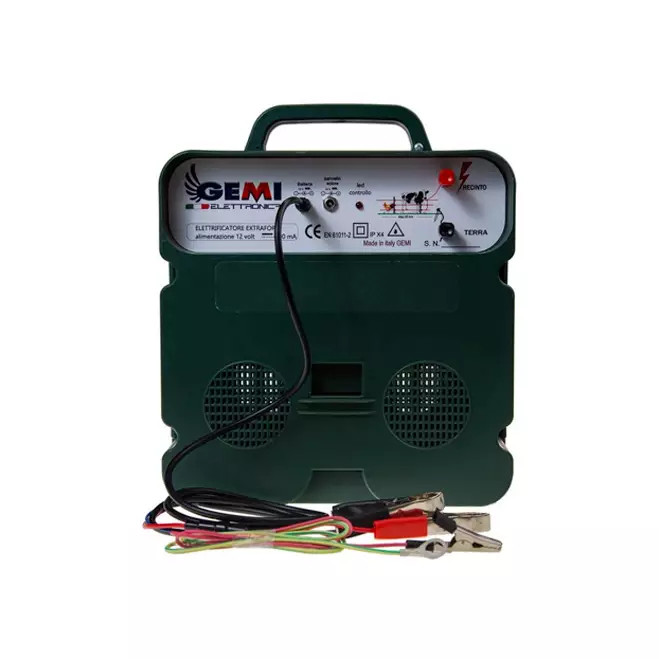
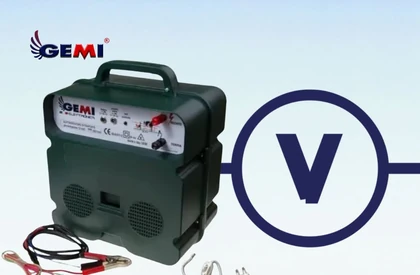
- B/12 battery-powered energizer 12V / 220V : powerful and stable, perfect for large fences.
- E/220 DEPOSITIZED energizer at 220 V current : depowered for small animals such as cats, dogs, rabbits and chickens
- B/12 battery-powered energizer 12V / 220V Designed to run on car or camper batteries, suitable for up to 5 km of fence.
Factors that cause voltage drop
One of the main problems in managing a fence is voltage drops along the line. You might have a Gemi Elettronica energizer that outputs 10,000 volts at the output, but only find 1,500 volts at the end of the perimeter. Why does this happen?
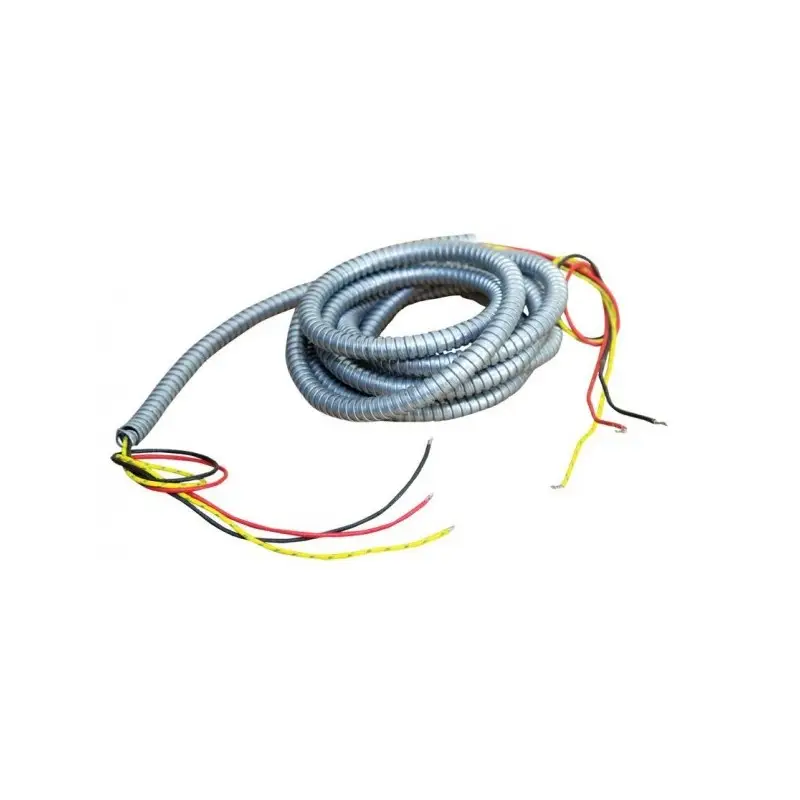
The main cause is ground faults. Every time a wire touches a conductive object (wet grass, uninsulated wooden poles, fallen branches), some of the volts "escape" to the ground instead of remaining in the wire. Using poor-quality conductors also has a negative impact: wires with many steel or copper strands have a lower electrical resistance and allow the volts to travel further. If the wire is too thin or rusty, the voltage will drop dramatically after just a few hundred meters.
How to Measure Volts Correctly
To find out how many volts your fence is actually supplying, you can't use a standard household multimeter, which would be damaged by high voltage spikes. You'll need a specialized electric fence tester .
These devices are connected to the wire and, using a probe inserted into the ground, measure the potential difference. Regular measurements at different points along the fence (at the beginning, middle, and end) are the only way to ensure the entire system is functioning properly. If you notice a sudden drop in voltage at a specific point, it's very likely a broken insulator or contact with vegetation is discharging the voltage to the ground.
Conclusions on ideal tension
In summary, to the question "how many volts does an electric fence have?", the correct answer is: enough to overcome the animal's resistance, but no less than 2,000 volts to ensure effectiveness .
Choosing a Gemi Elettronica energizer means relying on devices designed to maintain a constant and safe voltage, perfectly balancing power and consumption. Always remember that a good voltage isn't meant to harm, but to educate your pet: once it receives the first stimulus, it will be the voltage memory, not the physical wire, that keeps it inside (or outside) the protected perimeter.